-
My student Qipeng Qian (Program in Applied Mathematics, Univ. of Arizona) defended his PhD successfully on April 1st, 2026! His thesis Fundamental Properties and Applications of QuantumContinuous Variable Systems: Entropy, Estimation, and Detection will become available online soon.
-
In our new work, we prove that under minimal constraints on the physicality of a Wigner function, all states with purity μ<2/e satisfy the conjecture. Since we consider Wigner functions that are not necessarily physical, our results does not provide a negative answer to the conjecture. However, we find a large family of states that…
-

Our patent Processing Signals Using Entanglement-Assisted Communication has been granted. Patent No.: US 12,519,549 B2 Date of Patent: Jan. 6, 2026
-
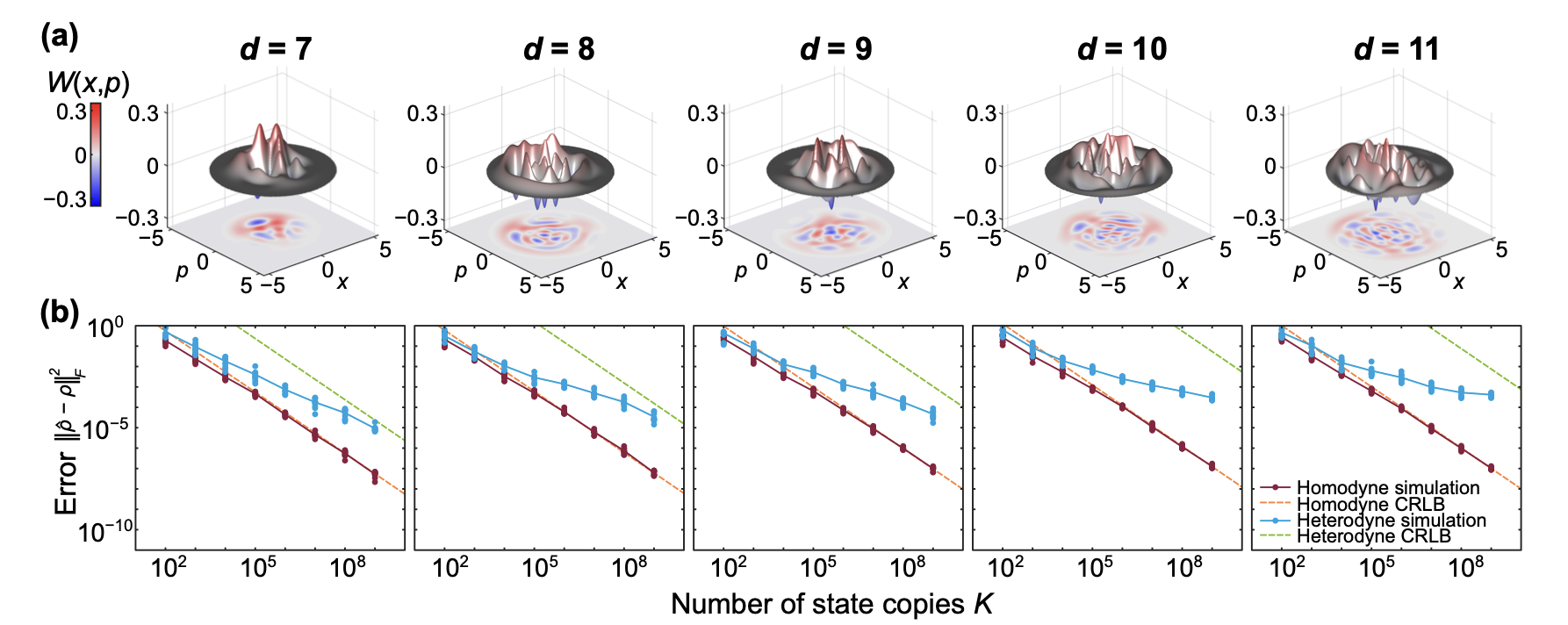
Our work Comparing Homodyne and Heterodyne Tomography of Quantum States of Light can be found on arXiv and we hope to get it into a journal soon!
-
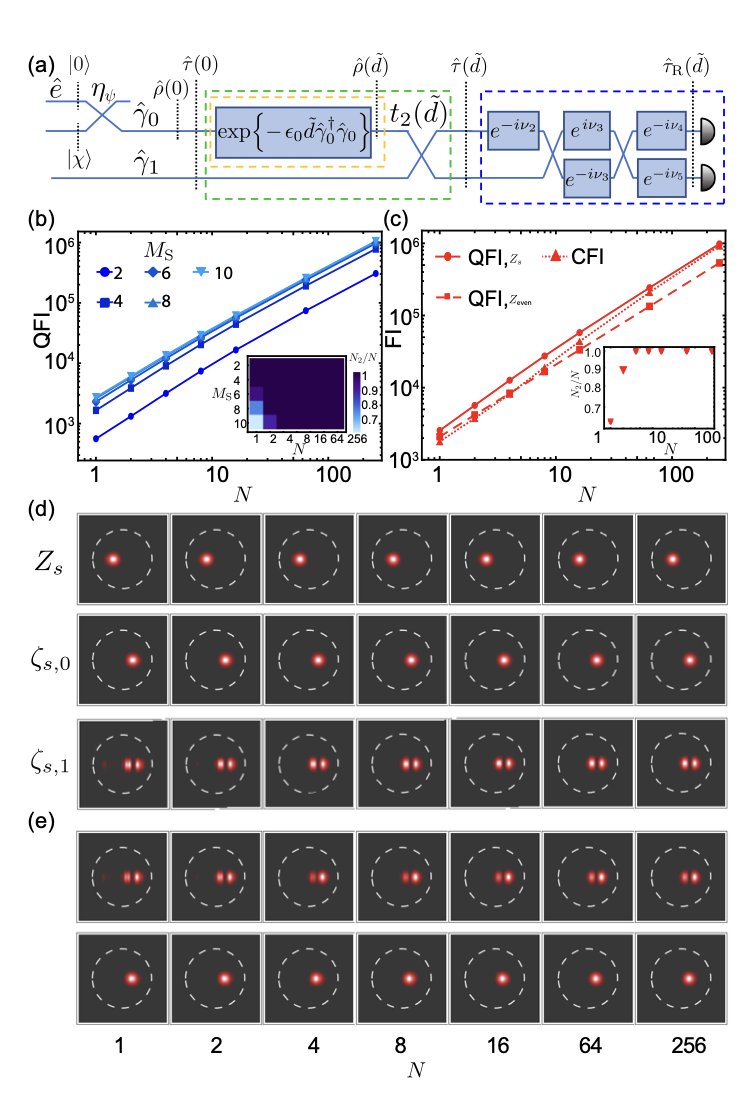
In our work “Optimal single-mode squeezing for beam displacement sensing”, we investigate the estimation of an optical beam’s transverse displacement is a canonical imaging problem fundamental to numerous optical imaging and sensing tasks. Quantum enhancements to the measurement precision in this problem have been studied extensively. However, previous studies have neither accounted for diffraction loss…
-

In “Bayesian Greedy Receiver for Pulse Position Modulation without an Error Floor under Thermal Noise” we examine quantum receiver architectures for demodulation of M-ary Pulse Position Modulation under thermal noise and photon-starved conditions. Building on the greed receiver framework, we analyze it using jointly optimized displacement-squeezing and the Dolinar receiver. We further introduce a novel slicing…
-

In our work we explore the effect of general partial-post selection followed by optimal measurement on the undetected part of the state. Full details can be found in the ArXiv version and the published version.
-
We generalize the problem of quickest quantum change point detection to to infinite-dimensional quantum systems. ArXiv version can be found here. Our work has been accepted to ITW 2025.
-
Boyu Zhou defended his thesis “Quantum Estimation utilizing Bayesian Techniques and Quantum Error Correction” on 10th of April 2025. He will be joining University of Toronto as a postdoctoral researcher.
-

In our recent work we consider the estimation of the separation of two incoherent point sources when prior knowledge on the separation is given. We compute the Minimum Mean Squared Error and the behavior of Direct Detection and SPADE. Our work can be found on arXiv. Update: Our work has been accepted to APL Quantum.